HAPA Newsletter

Letter from the Executive Director
As our legislative session has come to a close, a huge mahalo to each of you who continues to show up and engage. Although we are disappointed that many of our priority bills did not make it over the finish line this session, there were some meaningful wins, especially around our efforts to get corporate money out of our elections. I’m proud of the collective effort this session to fight for the common good in our food systems and local governance as well supporting our coalition partners working on tax fairness, protecting our local environment, and community safety.
For a full recap of how our fair & sustainable food systems policy agenda fared, visit our blog. Our Reclaiming Democracy Program Director, Aria Juliet Castillo provides an update on the state of our good governance policies below.
One huge win is SB2471! It is the first bill of its kind to curb the influx of corporate money that has flooded our elections following the Citizens United Supreme Court ruling in 2010. Mahalo to Senator Rhoads for introducing this bill, to the legislature for sending a strong bill to the Governor’s desk, and to Governor Green for signing it into law!
A friendly reminder that there are more of us everyday working people than the powerful elites. When we come together, and get organized we can create meaningful change to improve the daily lives of local residents.
Election season is right around the corner. If your elected leaders aren’t serving your community, vote them out! Primary elections are August 8th and the general election is November 3rd. Make sure you are registered to vote, and consider supporting candidates who will truly prioritize your communities needs first and foremost.
In solidarity,
Anne Frederick,
Executive Director
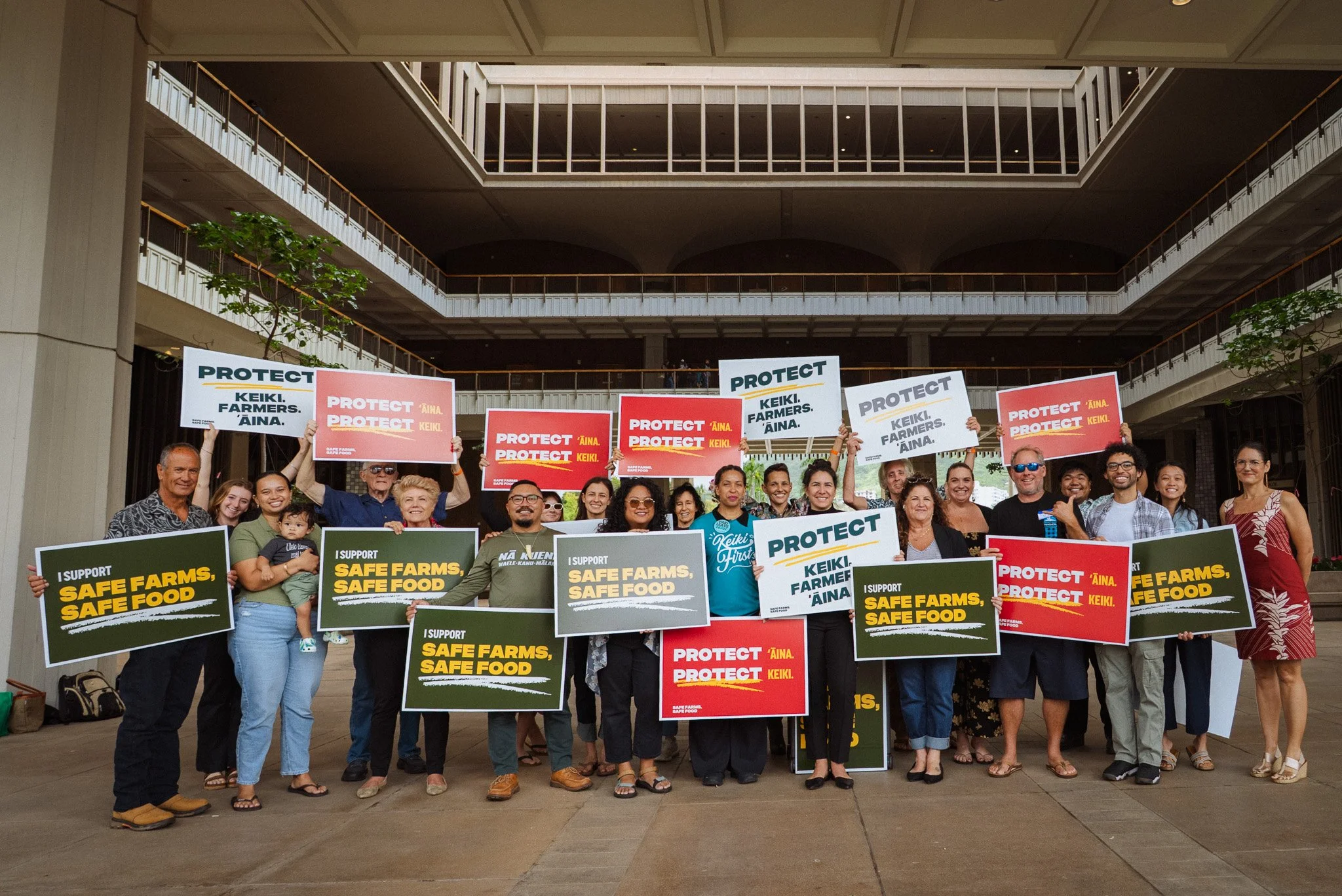
Members of the Safe Farms Safe Food Coalition gathered at the Capitol in March to call for greater pesticide protections for Hawaiʻi. Photo credit: Jordan Nakamura
Fair and Sustainable Food Systems
by Fern Holland, Pesticides & Public Health Campaign Director
This past legislative session closed without meaningful reform on pesticide use or reporting in Hawaiʻi, continuing a pattern that has now stretched over more than a decade. Despite strong community advocacy and years of documented concern, efforts to improve transparency, establish buffer zones, and restrict the most harmful chemicals once again stalled, were weakened, or failed to advance.
In my recent Civil Beat piece, “Thirteen Years of Asking. Another Year of Nothing,”,, I reflect on what this continued inaction means for the communities who have been consistently showing up, testifying, and asking for basic protections. The issue has never been a lack of evidence or engagement, it has been a lack of political will at the state level.
At the same time, this moment reinforces the importance of acting locally. While state authority ultimately governs pesticide regulation, counties and communities are not without power. We have opportunities to invest in and support agricultural and land use practices that reduce reliance on harmful chemicals, strengthen local food systems, and protect public health through land use decisions, education, and community-driven solutions.
If meaningful change continues to stall at the state level, then we must be willing to lead where we can, on the ground, in our neighborhoods, and through, backyard and local-level action that reflects the values we often speak about but too rarely implement.
Reclaiming Democracy
By Aria Juliet Castillo,
Reclaiming Democracy Director
Mahalo to Senator Karl Rhoads and Rep David Tarnas for their leadership this session. They make a great team as chairs of their respective Judicial Committees, and both showed great commitment to getting these good government priorities across the finish line. Senator Rhoads will be greatly missed, and we wish him the best in his next chapter.
Ending Citizens United in Hawaiʻi
Governor Josh Green's signing of SB2471, now Act 011, marks one of the most significant campaign finance reforms in Hawaiʻi in decades, restricting political spending by corporations and other "artificial persons" and moving our state closer to a democracy where power belongs to people, not corporate bank accounts. Since the Supreme Court's Citizens United decision equated corporations with people and political spending with free speech, billions in dark money have flooded elections at every level, including right here in Hawaiʻi, where outside spending has shaped races from governor to county council. There is still more work to do: billionaires can still spend unlimited personal wealth on elections, pay-to-play loopholes remain open, and dark money groups continue to spend without meaningful limits. But with Act 011 signed into law, Hawaiʻi has taken a real step toward a government people can trust, and HAPA will keep pushing until our democracy is truly not for sale.
Here are other good government priorities that made it to the Gov desk. What moved forward is the result of compromise, multiple years of hearings and testimony, and are far from perfect bills. Structural change doesn’t happen all at once. It happens step by step.
Truly Automatic Voter Registration
One of the simplest changes we can make. When someone becomes eligible and interacts with government agencies, they’re automatically registered to vote unless they opt out. No complicated paperwork. No missed deadlines. No unnecessary barriers. It’s a shift from “you have to figure it out” to “you’re already included.”
Partial Public Financing Improvements
For too long, Hawaiʻi’s public financing system hasn’t kept up with the real cost of campaigns — quietly favoring candidates with wealth or well-connected donor networks. This bill begins to change that by increasing available funding, strengthening small-dollar matching, and investing in a system that allows everyday people to run viable campaigns. It’s not a complete fix, but it’s real progress toward elections that reflect our communities.
Statute of Limitations Reform
Extending the timeline to hold bad actors accountable ensures violations don’t simply disappear with time. Accountability shouldn’t have an expiration date.
Unfortunately, not every effort to strengthen good government made it across the line.
Failure to Report Bribery
A basic expectation, that public officials must report corruption, still isn’t codified the way it should be. That’s unacceptable.
Closing the Pay-to-Play Loophole
Despite broad public support, efforts to stop contractors and those seeking government business from influencing elections did not pass. This loophole continues to undermine public trust and leaves the door open for undue influence.
These losses matter. They show just how entrenched the problem is — and why sustained pressure from our communities is essential. Change is possible, but it doesn’t happen without consistent, collective action.
More lawmakers are willing to take on big structural reforms. More community members are speaking up. And more people are demanding a government that works for them, not for special interests.
Next session, we come back to finish the job on pay-to-play, to strengthen anti-corruption laws, and to continue building a democracy that truly belongs to the people of Hawaiʻi.
Mahalo for being part of this work. Every email, every testimony, every conversation, all adds up.
Social and Economic Justice By Kencho Gurung, Communications Organizer
This legislative session brought some hard fights and a few important wins on the Social and Economic Justice front.
Pretrial Reform: Taking on the Two-Tiered Justice System
One of our key SEJ priorities this session was pushing for pretrial reform through HB 2413. Right now, roughly 50-70% of people sitting in Hawaiʻi's jails are pretrial detainees, meaning they haven't been convicted of anything. Many are there simply because they can't afford bail, not because they pose a public safety risk. This is essentially the criminalization of poverty.
HB 2413 would have created a presumption of release for many low-risk, nonviolent offenses and encouraged courts to use non-monetary release conditions instead of cash bail. It does not eliminate bail, but asks the system to stop treating wealth as a stand-in for danger. States like Illinois and New Jersey have already made similar reforms without any increase in crime… and saved taxpayer dollars in the process. Keeping someone in jail costs over $300 per person per day, while community supervision costs far less.
We mobilized our community to testify, and though this bill was eventually killed by the Legislature this year, we'll keep pushing for meaningful criminal justice reform that upholds the presumption of innocence for everyone.
Communities struggling economically are often the same ones living on the frontlines of environmental and public health injustices. That's why we continue to work in coalition with Hawaiʻi Community Safety, Reimagining Public Safety, Living Wage Hawaiʻi, Raise Up Hawaiʻi, the Hawaiʻi Workers Association, the Paid Leave Hawaiʻi Coalition, and others fighting on multiple fronts at once: wages, housing, tax fairness, criminal justice, and workers' rights.
Events
Celebrate 20 Years of Mālama Kauaʻi!